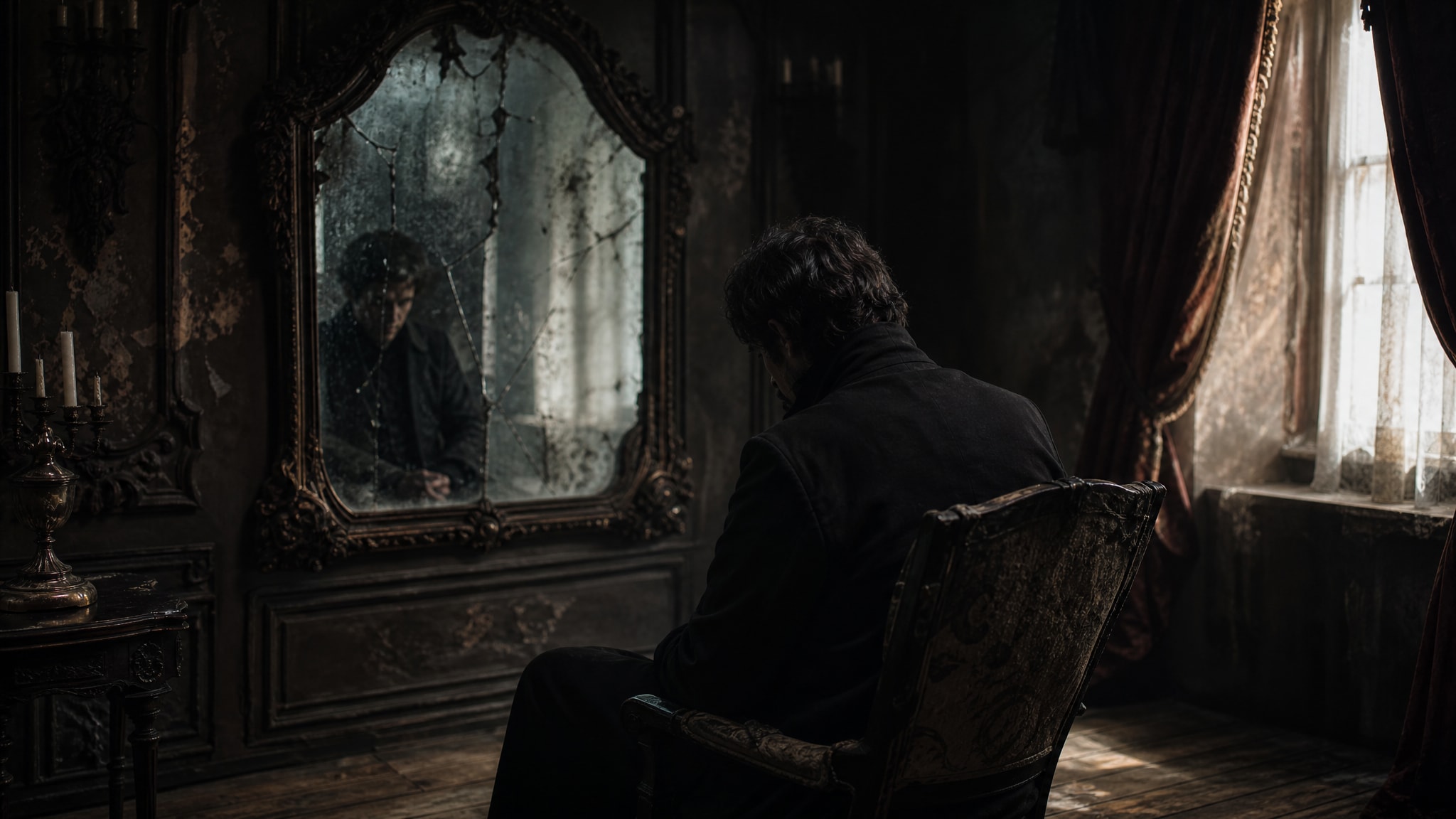
There is a particular kind of silence that settles over a room when you realize the person telling you the story cannot be trusted. It is not the silence of emptiness, but a heavy, suffocating presence, one where every whispered confidence might be a distortion born of grief or madness. For those of us who seek out gothic horror novels with unreliable narrators, this uncertainty is not a flaw to be corrected. It is the very texture of the dread we crave.
We do not read these stories to solve a puzzle or catch a liar in the act. We read them because the fractured voice speaks a deeper truth about the fragility of memory and the terrifying porosity between the living and the dead. When the narrator’s perception dissolves, the line between psychological collapse and supernatural intrusion blurs. You are left alone in the dark with nothing but your own uneasy instincts to guide you.
The Allure of Narrators You Can’t Trust in Horror
Literary critics have long argued that the gothic unreliable narrator is less a puzzle to be solved than an embodiment of repressed cultural anxieties about memory and identity. The device strips away the comfort of objective reality. It forces you to inhabit a consciousness actively failing to comprehend its own circumstances. The horror comes not from what is seen, but from the gap between what the narrator reports and what you sense is actually happening beneath the surface of the prose.
Defining the Unreliable Voice in Gothic Fiction
An unreliable narrator in this tradition is rarely a malicious deceiver plotting a twist for the final page. They are usually wounded, isolated, or overwhelmed by forces their language cannot fully contain, so their testimony reads as a record of erosion rather than fact. You encounter voices shaped by trauma, social confinement, or the slow encroachment of the supernatural, each offering a version of events that feels emotionally true even as it crumbles under scrutiny.
This instability is essential to the atmosphere of gothic horror’s first-person narration, where the terror is epistemological rather than visceral. The narrator’s failure to understand their world becomes your failure, creating an intimacy that an omniscient perspective can’t match, since omniscience offers safety through knowledge. In gothic fiction told in the first person, safety is the first casualty. What replaces it is a claustrophobic alignment with a mind that may be witnessing ghosts, or simply projecting its own ruin onto the walls.
Why Psychological Ambiguity Deepens Dread
Certainty is the enemy of haunting. Once a ghost is confirmed or a delusion diagnosed, the tension resolves into mere plot. Psychological gothic horror sustains its power by refusing that resolution, keeping you suspended in a state of perpetual questioning where every sensory detail carries a double meaning. The dread accumulates in the spaces between interpretations, growing heavier with each paragraph that refuses to say whether the threat is external or internal.
This ambiguity mirrors the actual experience of grief and mental distress, where the line between memory and hallucination often thins to nothing. When a narrator describes a shadow moving against the light, you feel the weight of their exhaustion and isolation as acutely as any spectral chill. The unreliability becomes a form of emotional honesty, an admission that human perception is always compromised by the wounds we carry.
Classic Gothic Fiction First Person Narration That Haunts
The foundations of this tradition were laid by authors who understood that narrative instability could critique social repression as much as generate terror. These early works set templates contemporary writers still follow, proving that the most enduring horrors are rooted in the limitations of human testimony rather than the excesses of imagination. Their narrators remain unsettling precisely because the unreliability comes from recognizable human constraints, not contrived deception.
Victorian Voices and Repressed Truths
Victorian gothic fiction often used compromised narrators to explore what could not be spoken aloud in polite society. The fragmented testimonies of governesses, servants, and socially marginalized women showed how narrative authority itself was contested ground, where truth depended on whose voice was permitted to speak. These characters did not merely witness hauntings. They embodied the haunting quality of suppressed histories pressing against the boundaries of acceptable discourse.
Their accounts are marked by hesitation, self-correction, and elaborate protestations of sanity that only deepen your suspicion. You sense the enormous pressure shaping every sentence, the way social expectations force traumatic experience into coded language that reveals and conceals at once. This restraint creates a tension more potent than explicit confession, since the gaps in the testimony become the sites where the true horror lives.
The Legacy of Epistolary Doubt
The epistolary form amplified this uncertainty by presenting truth as something assembled from fragments rather than received whole. Letters, diary entries, and discovered manuscripts built narratives where chronology broke and perspective multiplied, so no single voice could claim authority. Each document arrived bearing the marks of its creator’s limitations, forcing you to become an active investigator piecing together a reality the characters themselves could not see.
This structural fragmentation anticipated modern psychological gothic horror by treating narrative coherence as suspicious rather than reassuring. When a story arrives pre-broken, you accept discontinuity as natural, and doubt seeps into every transition between documents. The form itself becomes unreliable, mirroring the way memory and testimony fracture under experiences that resist orderly recounting.
Modern Psychological Gothic Horror Novels With Fractured Voices
Contemporary literary horror increasingly treats unreliability as a device for emotional truth-telling rather than misdirection, in line with a broader shift toward trauma-informed storytelling. Today’s fractured narrators are not puzzles to decode but witnesses whose distortions reveal the lasting impact of violence, loss, and institutional erasure. Their voices carry the weight of lived experience even as they struggle to say what has been done to them, and what they have done in return.
Contemporary Masters of Narrative Deception
Modern authors have refined the unreliable narrator into an instrument of psychological exploration, moving past shock twists toward sustained atmospheric unease. These writers understand that deception in service of theme differs from deception in service of surprise, using narrative instability to examine how trauma reshapes perception over time. You find yourself trusting the emotional accuracy of a narrator’s account even while doubting its factual precision, because some truths can only be approached obliquely.
Shirley Jackson’s use of Eleanor Vance’s dissolving perspective in The Haunting of Hill House remains a benchmark for how interiority can render physical space untrustworthy. Her influence echoes through work where domestic settings become extensions of troubled psyches, where wallpaper patterns shift with mood and corridors lengthen according to guilt. These narrators do not merely observe haunted spaces. They collaborate in the haunting, their perceptions actively building the architecture of dread.
Domestic Spaces as Mirrors of Mental Decay
The home in modern gothic fiction rarely offers sanctuary. Instead it functions as a container where private collapses unfold beyond any external witness. Narrators confined to these spaces develop relationships with their surroundings that blur environment and psyche, describing rooms with the same intimate confusion they apply to their own thoughts. The domestic setting amplifies unreliability precisely because it should be knowable, so its distortion feels like a personal betrayal rather than a generic supernatural event.
You recognize these spaces as extensions of the narrator’s interior landscape, where cluttered hallways mirror tangled memories and locked doors stand for forbidden knowledge. The house becomes a second narrator, its silences and creaks offering counterpoint to the protagonist’s increasingly strained testimony. This doubling creates rich interpretive possibilities, as you weigh the narrator’s words against the evidence of their environment, searching for truth in the tension between them.
Crafting Close First-Person Dread: Lessons for Readers and Writers
Understanding how atmospheric literary horror prioritizes voice over conventional plotting changes how you approach both reading and writing in the genre. Close first-person narration requires surrendering the impulse to explain, trusting that accumulated sensory detail will generate meaning without explicit articulation. This demands patience from readers and courage from writers, since both must accept uncertainty as the medium through which deeper truths emerge.
Sensory Immersion Over Plot Exposition
In writing The Circle of Witham Grange, I found that anchoring the supernatural in a narrator’s sensory confusion let the boundary between life and death feel porous rather than theatrical. The narrator perceives the world through layers of exhaustion and grief, so supernatural intrusions arrive as disruptions in texture and temperature before they manifest as visible phenomena. This grounds the uncanny in bodily experience, making it feel like an extension of psychological states rather than an external imposition.
Readers seeking narrators you can’t trust in horror should look for this sensory density as a marker of serious atmospheric work. When a narrator dwells on the weight of air or the specific quality of silence in a room, they are building the foundation on which unreliability can rest without collapsing into gimmickry. The body becomes the site where truth and distortion meet, offering evidence that exists below the level of conscious narration.
Balancing Empathy and Suspicion
The most effective unreliable narrators keep your sympathy even as they undermine your trust, creating a relationship complicated by genuine care. You want to believe them because you understand why they need to believe themselves, even as the evidence piles up that their perceptions have warped beyond recognition. This emotional investment keeps unreliability from becoming a mere intellectual exercise, so the eventual dissolution of certainty carries real weight.
Achieving this balance means revealing the narrator’s vulnerabilities alongside their distortions, showing how their unreliability protects them against unbearable truths. You see what their delusions do for them, and you understand that abandoning them would mean confronting something worse than confusion. This compassion does not resolve the ambiguity. It deepens it, since the narrator’s flaws are also their survival mechanisms.
Unreliable Narrator Horror Books Set in Haunted Estates
Haunted estates provide the perfect crucible for narrative unreliability because they combine architectural complexity with historical weight, creating environments where perception naturally fractures. These houses accumulate stories that contradict each other, offering narrators multiple pasts to choose from and none to verify with certainty. The estate becomes a collaborator in deception, its hidden passages and forgotten rooms standing in for the narrator’s concealed truths.
Architecture as an Extension of Memory
Crumbling mansions and isolated granges function as externalized psyches, their decay mirroring the narrator’s deteriorating grasp on coherent narrative. Rooms hold memories like sediment, releasing them unpredictably in response to emotional triggers rather than chronological logic. You move through these spaces experiencing time as the narrator does, where past and present sit in uncomfortable proximity and every threshold promises revelation or repetition.
The architecture resists mastery. It refuses to yield its secrets to systematic exploration or rational analysis. Narrators who try to map these spaces inevitably produce incomplete charts, their documentation marked by absences that correspond to their own psychological blind spots. The house knows what the narrator cannot admit, holding truths in its foundations that the conscious mind has buried beneath layers of protective forgetting.
When the House Knows More Than the Narrator
This dynamic creates a distinctive form of dramatic irony, where the setting possesses knowledge denied to the voice describing it. You sense the house’s awareness through details the narrator mentions without understanding their significance, through patterns they notice but fail to interpret correctly. The estate becomes a silent witness whose testimony exists in wood and stone rather than language, offering evidence that contradicts or complicates the narrator’s account.
For readers drawn to this intersection of place and psyche, order The Circle of Witham Grange paperback to see how estate-based gothic fiction sustains narrative uncertainty through architectural atmosphere. The novel shows how haunted spaces can amplify unreliability without overwhelming the human drama at their center, keeping focus on character even as the environment presses inward. Such works remind us that the most haunting houses are the ones that reflect our own capacity for self-deception back at us with patient, unblinking clarity.
Finding Your Next Atmospheric Read Beyond the List
Genre tags and marketing copy rarely capture the specific texture of voice that makes atmospheric literary horror resonate with particular readers. You learn to recognize promising work through opening pages that establish narrative rhythm before plot, through sentences that carry weight beyond their informational content. Trust your response to the prose itself. Notice whether the voice invites you into comfortable familiarity or unsettles you through a subtle wrongness that accumulates across paragraphs.
Pay attention to how narrators handle moments of crisis, whether they retreat into clinical detachment or dissolve into sensory overload. Both responses can signal unreliability, but they create very different reading experiences suited to different temperaments and moods. Your own preferences here are valid guides, more reliable than bestseller lists or recommendation algorithms that cannot tell atmospheric dread from manufactured suspense.
Seek out authors whose work rewards rereading, where the initial confusion resolves not into clarity but into richer ambiguity. These are the voices that treat unreliability as an ongoing conversation rather than a problem to be solved, inviting you back with new questions each time. My own newsletter offers regular dispatches on such works, for readers who value narrative texture over conventional satisfaction.
Why We Return to Stories Where Truth Is Elusive
In an era saturated with false certainty and performed confidence, there is relief in narratives that honor the fundamental unknowability of human experience. These stories admit what we already suspect in our quieter moments: that memory is reconstruction, that perception is interpretation, that the selves we present are always partial fictions. The unreliable narrator does not betray us. It accompanies us into territory where honest testimony requires admitting the limits of testimony itself.
We return to these haunted voices because they speak to our own relationship with mortality and the persistence of what cannot be fully grasped. The boundary between living and dead that gothic fiction explores is, in the end, the boundary between knowing and not knowing, between the stories we tell and the truths those stories cannot contain.
Frequently Asked Questions
What makes a narrator unreliable specifically in gothic horror versus other genres?
In gothic horror, unreliability stems from psychological wounds, social repression, or supernatural interference rather than deliberate deception. The narrator’s distortions serve thematic exploration of memory, grief, and identity rather than plot twists. Their unreliability embodies the genre’s central concern with the fragility of human perception when confronted with forces beyond rational comprehension.
How does first-person narration create more dread than third-person in gothic fiction?
First-person narration eliminates the safety net of omniscient perspective, forcing readers to share the narrator’s limited and potentially distorted viewpoint. This creates claustrophobic intimacy where every uncertainty becomes your own, and where the boundary between psychological collapse and supernatural intrusion remains permanently blurred. The dread emerges from inhabiting a consciousness that cannot trust its own perceptions.
Can unreliable narrator horror avoid cheap twist endings while remaining satisfying?
Yes, when unreliability serves emotional truth rather than misdirection, the satisfaction comes from accumulated atmosphere and psychological depth rather than revelation. The best examples sustain ambiguity throughout, rewarding readers with richer understanding of character and theme upon reflection. Resolution arrives as emotional recognition rather than factual clarification, honoring the complexity of human experience.
Why are haunted houses such common settings for unreliable narrators?
Haunted estates externalize psychological states through architecture, providing physical corollaries for the narrator’s internal confusion and repressed memories. The house’s complexity mirrors the narrator’s fractured perception, while its history offers multiple conflicting narratives that prevent authoritative truth claims. This environmental doubling amplifies unreliability by making the setting itself a participant in the narrative’s uncertainties.
Leave a Reply